

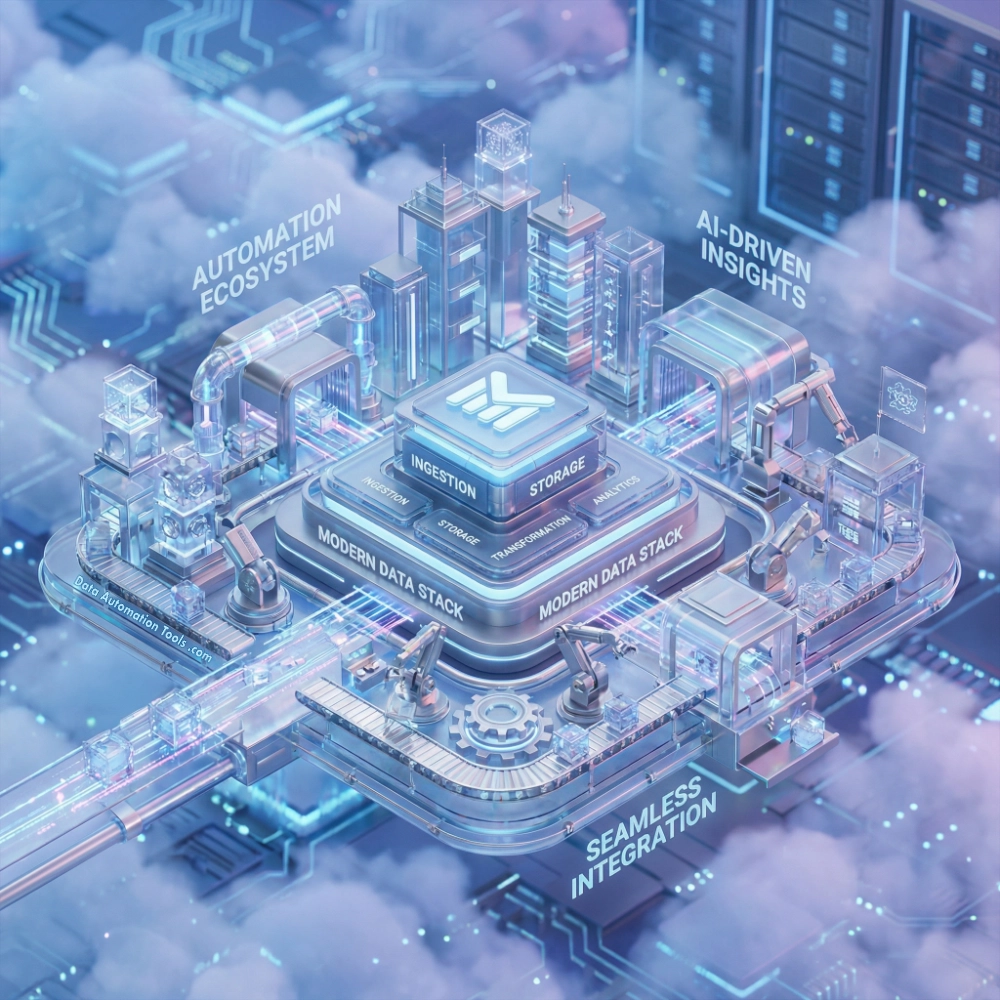
A decade ago, the modern data automation stack could be sketched on a napkin. Today, that napkin looks like a subway map. Data is coming from everywhere, being processed in multiple ways, and consumed by humans, applications, and machine learning systems all at once. The modern data stack didn’t get complicated because vendors wanted it to — it got complicated because businesses did. Real-time products, SaaS sprawl, compliance, AI, and global scale all pulled data in different directions, and the tooling evolved to survive that chaos.
What’s interesting isn’t that we now have dozens of tools — it’s that those tools have settled into recognizable roles. Whether you’re at a startup or a Fortune 100, the same categories show up again and again, because they solve fundamental problems that don’t go away.
Ingestion Is Where Reality Smashes Your Architecture
Everything starts with ingestion, and this is where most systems quietly die. Source systems don’t behave. APIs rate-limit you. Schemas drift. Events arrive out of order. This is why tools like Fivetran, Airbyte, Stitch, Kafka, Kinesis, and Pub/Sub exist: not because moving data is hard, but because moving unreliable, changing, high-volume data is.
The modern data automation pattern is to ingest raw data into a warehouse or lake as fast and faithfully as possible. You don’t try to be clever at this stage. You just capture what happened. Fivetran and Airbyte dominate the SaaS-to-warehouse world because they absorb the pain of API quirks and schema changes. Kafka and Kinesis dominate event streams because they let systems talk without tightly coupling to each other. Ingestion tools are really shock absorbers. If they fail, everything else feels it.
Warehouses and Lakehouses Became the Center of Gravity
Once data lands, it needs somewhere to live that can handle scale, concurrency, and unpredictable workloads. This is where Snowflake, BigQuery, Redshift, and Databricks earned their power. These aren’t just databases anymore — they’re execution engines for the entire company.
The key shift is that the warehouse is now the place where most computation happens. Instead of pushing data through a maze of external servers, teams load raw data and transform it inside the warehouse using SQL or Spark. This is what made ELT win. Warehouses got fast and cheap enough that it became smarter to move logic to where the data already lives.
Databricks pushes this even further by blending analytics, data engineering, and machine learning into a single lakehouse model. Snowflake and BigQuery stay closer to pure analytics, but all of them now act as the backbone of the modern data automation platform.
Transformation Is Where Meaning Is Created
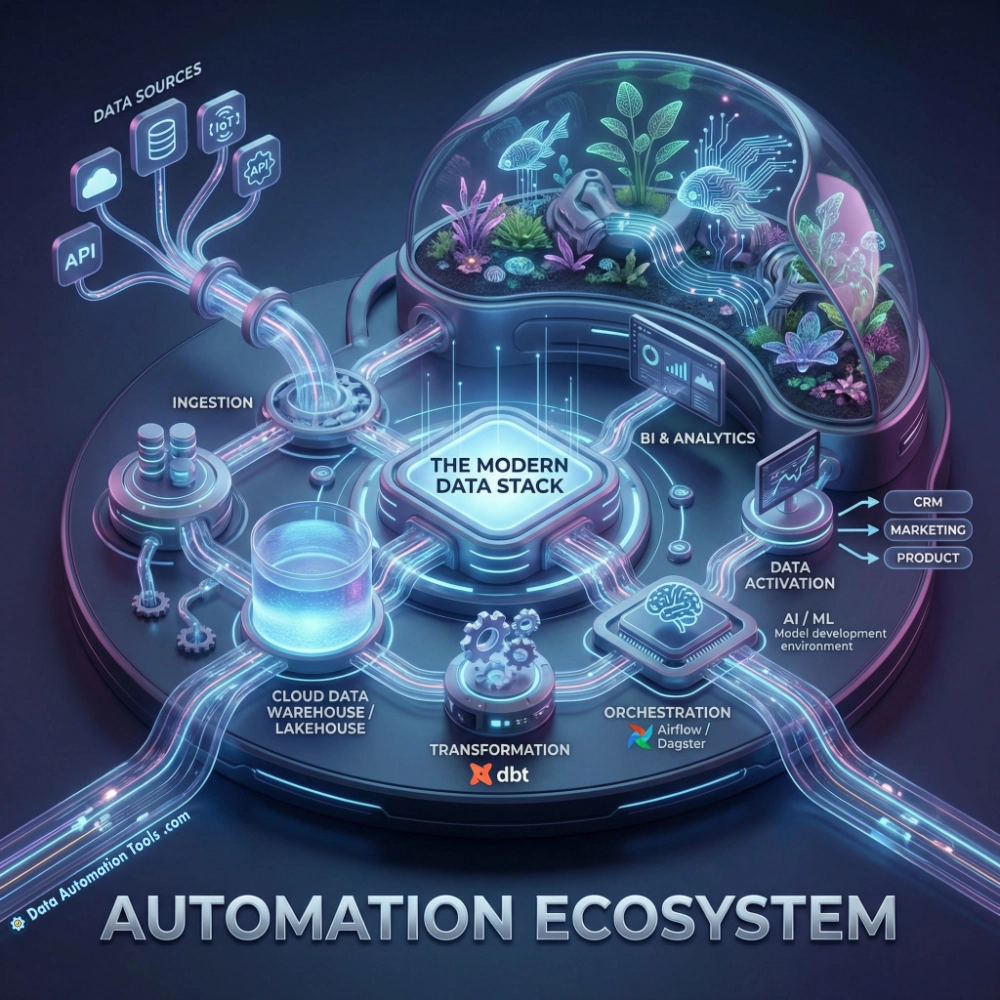
Raw data is useless without transformation. This is where dbt, Spark, and SQL-based modeling layers take over. dbt, in particular, changed the game by making transformations feel like software. Models are versioned. Tests exist. Lineage is visible. Pull requests replace tribal knowledge.
This is also where governance quietly happens. When transformations are code, you can enforce naming standards, metric definitions, and quality checks. You can answer “what is revenue?” by pointing to a model instead of a meeting. That’s why transformation tools are really about trust as much as they are about reshaping data.
Spark still dominates when things get truly big or complex — heavy joins, ML preprocessing, streaming pipelines. But for analytics, dbt plus a warehouse has become the default because it’s fast to build, easy to reason about, and easy to change.
Orchestration Keeps the Whole Thing from Falling Apart
Once you have ingestion, storage, and transformation, you need something to run it all in the right order. This is where Airflow, Dagster, Prefect, and cloud schedulers come in to the modern data automation ecosystem. They don’t move data themselves — they coordinate the chaos.
Airflow is the old workhorse: powerful, flexible, and a bit of a beast to manage. Dagster and Prefect represent the modern wave, focused on data-aware pipelines, better testing, and developer ergonomics. These tools matter because data workflows are not just jobs; they’re graphs of dependencies. If something breaks upstream, you want to know before it poisons everything downstream. Without orchestration, modern stacks turn into a pile of cron jobs and wishful thinking.
Data Analysis Tools Are the Human Interface
Power BI, Tableau, Looker, Sigma, and QuickSight sit at the edge of the system where humans actually see the data. They don’t just visualize — they shape how the organization thinks. A good data analysis tool makes complexity disappear. A bad one makes every question feel political.
These tools fight over the same five tensions: governance, usability, concurrency, extensibility, and cost. Power BI wins on price and Microsoft gravity. Tableau wins on visual exploration. Looker wins on semantic governance. Sigma wins by living directly on the warehouse. None of them are perfect, which is why companies mix them with modeling layers, APIs, and embedded analytics.
Reverse ETL and Activation Close the Loop
The modern data automation stack doesn’t stop at dashboards. Tools like Hightouch and Census push modeled data back into operational systems — CRMs, marketing platforms, support tools. This is how analytics becomes action. Instead of staring at a list of churn-risk customers, you push that list into Salesforce or HubSpot and trigger workflows.
This is the last mile of the modern data automation stack, and it’s where a lot of business value is unlocked.The Real Pattern Is Convergence. The modern data stack looks messy, but it’s actually converging. Warehouses became compute engines. Transformation became software. BI became a semantic and UI layer. Orchestration became data-aware. Reverse ETL turned analytics into operations.
The Lesson of Modern Data Automation
The moral of this story is a that the modern data automation ecosystem is architectural mindset. The best stacks don’t try to do everything in one tool. They let each layer do what it’s good at and keep the interfaces between them clean. That’s how you get speed without losing control, and flexibility without losing trust.
Modern Data Automation FAQs (With No Easy Answers)
Should data be transformed before it enters the warehouse (ETL) or after it lands in the warehouse (ELT). This debate touches cost, governance, performance, and who owns business logic.
How much of the stack should be real-time versus scheduled? Streaming enables instant reaction but adds massive complexity; batch is cheaper, simpler, and more reliable.
Should data be owned by a central data team or by individual product and domain teams? This affects governance, velocity, and data quality.
Should pipelines be written in Python/SQL (Airflow, dbt, Dagster) or built with visual tools (Zapier, Workato, Talend). This is a fight between developer control and business-user accessibility.
Should the warehouse be the center of gravity, or should Kafka-style event streams become the backbone of data automation? This decision shapes latency, cost, and how systems integrate.