

Estimated reading time: 11 minutes
Data automation tools are full-on full stack these days, in various combinations, across all layers, touching every bit of every byte. So lump it or leave it, because data professionals can’t escape the “Full stack” zeitgeit/bandwagon/steamroller/hype (choose your own adventure).
Most of us see “agile generalist” as the career role we’re being shunted into. But wait a second! What does it all mean? And why is the full stack data automation tool juggernaut so ineluctable?
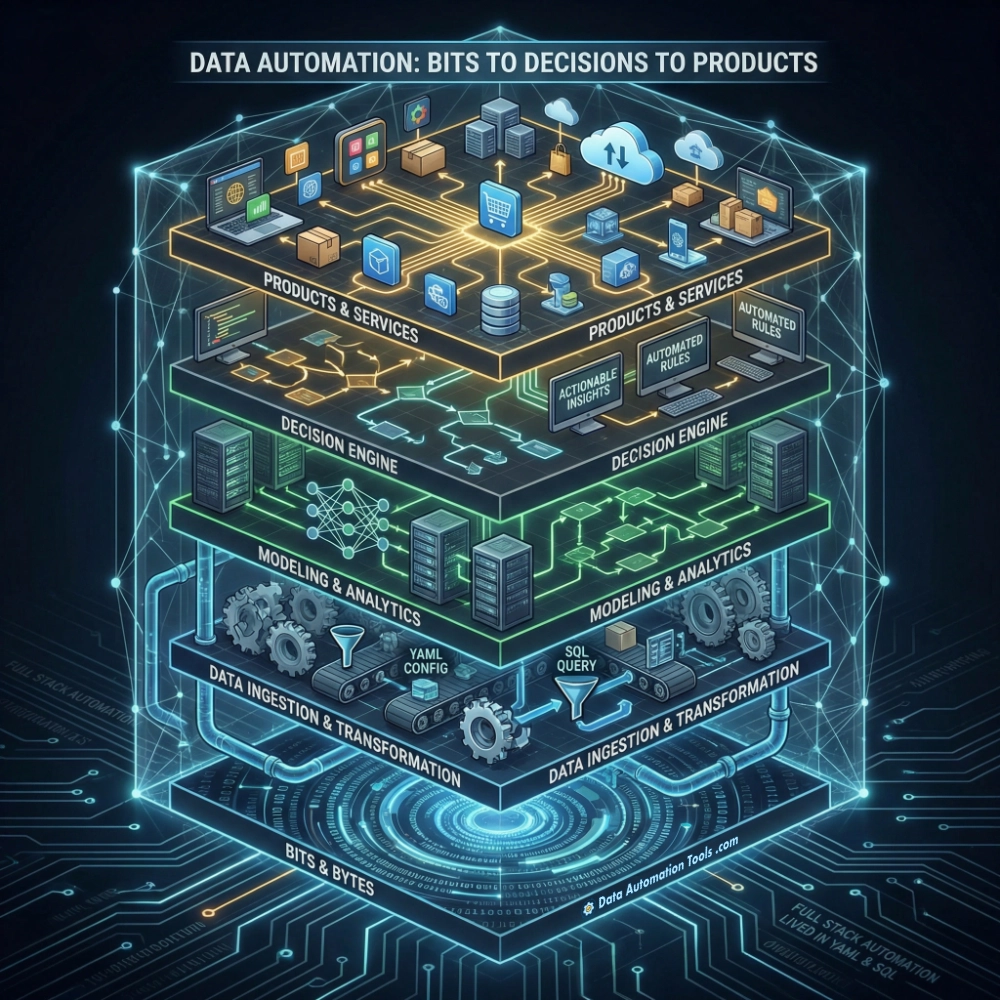
Simple nuts: full stack is seen as the most pragmatic response to the increasing complexity of how our organizations collect, store, transform, and use information. As data volumes grew and sources proliferated exponentially—from transactional databases and SaaS tools to event streams and logs—teams long ago began informally separating concerns: first getting data in, then storing it reliably, then modeling and transforming it, then serving it to downstream users and systems, and finally managing cross-cutting issues like governance and reliability.
Over time, this separation coalesced into a layered mental model, reinforced by the way cloud platforms and popular tools naturally aligned into those roles.
Questions of algorithmic framing aside, the “full stack” is now a shared language for data engineers, analysts, and stakeholders to delegate responsibilities (btw: it’s always the engineer’s job—always), choose tools that fit a particular layer, and understand how local changes ripple through an end-to-end architecture.
Which is all to say that this mental model of a layered architecture in which bits become decisions, and decisions become products is a reality lived in YAML, SQL, and Terraform. What follows is a tour of the five favorite flavors of the full stack—ginger ingestion, strawberry storage, banana transformation, almond analytics, and plain ol’ vanilla governance. To keep it spicy, we’ll be dropping a metric tonne of practitioners’ favorite tool names on you, so buckle up babies, keep yr ingestion engines hot, and please don’t forget your goggles.
Full Stack Allure aka “Neapolitan” is the Best
I know I got us all excited, but one more word about the forest before we plow into the trees (don’t worry, this pause, and that metaphor are all just part of the foreplay). For data professionals, the appeal of the getting your hands on the full stack of data automation tools lies in three main benefits that carry through all layers: abstraction, reliability, and extensibility. Abstraction, aka not having to reinvent cron jobs or write ad hoc scripts for every integration, means you can use declarative configuration, visual DAGs, or code-driven frameworks to express pipelines. Reliability means these tools handle retries, logging, and error alerts out of the box, so you don’t get a call at midnight to figure out what broke the analytics charts for tomorrow’s presentation. Extensibility ensures you can plug in custom logic: Python operators in Apache Airflow, Node-based scripts in n8n, or dbt models running SQL transformations—all without leaving the automation ecosystem.
That ecosystem of fully integrated data automation tools is incredibly rich and varied. On one end, you have open-source orchestrators where you build workflows as code, test them like code, and deploy them like code. These shine in environments where control, customization, and versioning are non-negotiable.
On the other end are low-code/no-code data automation that democratize integration tasks by exposing visual interfaces and prebuilt connectors. In between, you’ll find specialized transformation engines and ELT services that standardize ingestion but leave transformation to the warehouse layer. So choosing the right tool depends heavily on which layer you’re working in (or between).
In my experience, the biggest frame shift has been treating automation pipelines as software assets rather than throwaway utilities, applying the same rigor to version control; CI/CD integration; testing; monitoring; and documentation. The risks are legion, but the payoff is enormous. Proper automation doesn’t just save time—it enforces consistency, reduces human error, and creates transparency around how data flows through your systems. But enough about gists and ‘geists. Let’s get back to the stack.
Layer 1. Ingestion
Every stack begins at the membrane between your systems and the outside world (I like to think of it as the blood-brain barrier)—the data ingestion layer, where disparate operational databases, SaaS tools, event streams, and flat files are coaxed into some semblance of order. This is the domain where “time to first data” is won or lost.
For batch and SaaS replication, change data capture (CDC) and connector-centric platforms have become the workhorses. Tools like Fivetran or Airbyte are valued for their ability to turn a menagerie of sources—Postgresql, Salesforce, Netsuite—into a managed fleet of pipelines that “just run,” with schema evolution, incremental loading, and connector maintenance abstracted away. Engineers prize them less for their novelty than for their reliability; they remove a category of fragile bespoke scripts that no one wants to own.
Where data is born as events, the ingestion layer is defined by durable, horizontally scalable logs. Apache Kafka and cloud equivalents such as Amazon Kinesis or Google Pub/Sub remain canonical because they offer a shared, replayable history of what happened in the business, decoupling producers from consumers and enabling downstream reprocessing when schemas or logic inevitably change. This is the difference between treating history as a traceable record versus a series of one-way ETL jobs.
Glueing these pieces together are workflow orchestrators—Apache Airflow in many organizations, along with modern contenders such as Dagster or Prefect. Orchestrators are valued not merely as cron-on-steroids, but as the control plane for ingestion: they encode dependencies (this CDC job must finish before that S3 export), manage retries and backoff, and provide a living documentation of how data enters the platform. Done well,, ingestion isn’t a scattered set of scripts; it is a well-described system with clear contracts and runtime guarantees.
2. Storage
Once data crosses the membrane, it has to land somewhere that can support both growth and curiosity. This is the data storage layer: the substrate on which almost every other layer depends.
The archetypal storage tools here are in the data warehouse, data lake, and lakehouse categories, and if you find the terms unhelpful, you’re not alone (I’ve written a helpful comparison of the three containers here if you’re interested in a deeper dive). Amond these, Snowflake, BigQuery, and Databricks are favored not only for raw performance, but for the way they blend elastic compute with managed storage, making it feasible for small teams to behave like internal data platforms. Practitioners value the separation of storage and compute, columnar formats, and automatic clustering or partitioning; these features make it possible to support dozens of workloads without descending into index micromanagement.
In parallel, the data lake—usually S3, GCS, or Azure Data Lake, backed by open formats—remains essential. Parquet and ORC, combined with table formats like Apache Iceberg or Delta Lake, provide ACID semantics on top of object storage, solving the long-standing problem of “how do we avoid users reading half-written files?” Tools in this layer are prized for durability and openness: once landing zones and curated zones follow a predictable layout and schema evolution is safely handled, data engineers gain the confidence to treat the lake as a long-lived, canonical store.
Crucially, the storage layer is not just bits-on-disk; it is also the catalog that makes those bits discoverable. Hive Metastore, AWS Glue Data Catalog, or a lakehouse’s integrated catalog provide the namespace where tables and views are named, typed, and governed. Without a solid catalog, the lake degenerates into what every engineer dreads—a swamp in which every new project digs its own grave.
Layer 3. Transformation
In the data transformation layer, raw, heterogeneous data is refined into coherent models: fact tables, dimensions, feature sets, and domain-oriented marts. This is where data engineers exercise their craft most visibly, encoding business semantics into reproducible logic.
The flagship tool here, in many modern stacks, is dbt. Its value lies not merely in templated SQL, but in bringing software engineering discipline to analytics: modular models, explicit dependencies, version control, and testable contracts. Engineers appreciate how dbt’s DAG makes lineage intelligible: if a KPI is wrong, one can trace its ancestry through intermediate models back to the raw source. That lineage becomes a shared map for analytics engineers, scientists, and even product managers.
For workloads that transcend SQL—streaming transformations, heavy joins at scale, or ML feature computation—distributed engines like Apache Spark, Flink, or cloud-native equivalents come to the fore. These are data automation tools valued for their ability to operate directly on the lake with pushdown predicates and for integrating with the same catalog and table formats used by the rest of the stack. A well-integrated transformation layer means a single logical table can be materialized by a mixture of batch SQL, continuous streams, and ML pipelines, all sharing governance and access control.
Complementing these engines are testing and quality tools: unit tests embedded in dbt, contract testing in orchestrators, and even data quality platforms that assert invariants (no negative prices, no orphaned foreign keys). They are prized because they convert “we think this pipeline works” into “we have encoded what ‘working’ means and we check it on every run.” The transformation layer is where a platform shifts from being a passive record of events to an engine that produces trustworthy, reusable information assets.
Layer 4. Data Analytics
No matter how elegant the upstream layers, the stack fails if data cannot be consumed easily and safely. The analytics layer is where tables, models, and features are shaped into experiences: dashboards, APIs, embedded analytics, and operational feedback loops.
Business intelligence tools—Looker, Tableau, Power BI, and others—remain central at this layer. Their value, from a data engineering perspective, lies in centralizing semantic definitions (dimensions, measures, drill paths) and pushing as much logic as possible back into the warehouse or lakehouse. A well-governed BI layer minimizes “spreadsheet drift,” where metrics are reinvented in every analyst’s workbook, and ensures that dashboards become reliable interfaces to shared truth rather than bespoke visualizations of private logic.
For use cases that demand low-latency access or operational integration, serving often relies on specialized stores and APIs. Feature stores in the ML ecosystem, key-value caches, or materialized views in systems such as Postgres, ClickHouse, or specialized serving layers enable sub-second retrieval of model inputs and predictions. These data automation tools are valued because they bridge the chasm between analytical and operational worlds: the same feature definition that powers an offline training job can be used to serve online inference in production.
More recently, metrics layers and headless BI services have emerged to sit between the warehouse and consumption tools, exposing metrics via SQL, GraphQL, or REST. Data engineers value these because they impose a single, declarative source of metric definitions, reducing ambiguity when multiple tools read from the same warehouse. The serving layer, at its best, makes data products first-class citizens: versioned, discoverable, and consumable via standard interfaces.
Layer 5. Governance
Running through the entire stack of data automation tools is a cross-cutting layer that is both invisible and indispensable: governance and observability. It is here that questions of lineage, access control, data quality, and reliability are answered—or ignored at one’s peril.
Data catalogs and discovery platforms, such as open-source or commercial offerings, anchor this layer. Their most valued trait is the ability to tie together technical metadata (schemas, columns, run histories) with social context (owners, usage patterns, annotations). They turn the sprawl of thousands of tables into a navigable landscape, allowing engineers and analysts alike to answer “what does this table mean?” without diving into source code or institutional memory.
Observability platforms and data quality monitors complement this by providing continuous visibility into freshness, volume anomalies, schema drift, and failed expectations. They’re prized for reducing time-to-detection when something breaks in a dark corner of the DAG and for surfacing impact: which downstream dashboards, models, or teams will be affected by this failed load? In the absence of such tools, organizations rely on “monitoring by complaint”—an expensive and demoralizing feedback loop.
Finally, access control and privacy tooling—fine-grained permissions in the warehouse, column- and row-level security, masking of sensitive attributes, and policy-as-code systems—give structure to what might otherwise be ad hoc gatekeeping. Data engineers value systems where policies are explicit, versioned, and testable, because they reduce the risk that a well-intentioned change to a pipeline inadvertently exposes sensitive data or violates regulatory constraints.
Seen together, these five layers describe more than a stack of technologies; they outline a progression of data automation tools from raw exhaust to governed products. Ingestion makes the world legible; storage makes it durable; transformation makes it meaningful; serving makes it useful; and governance and observability keep it all honest. The tools we prize at each layer are those that allow small teams to operate with the composure of much larger organizations, by turning chaos into contracts and contracts into capabilities.
The Lynchpin of Full Stack Automation
The logic motivating the progression toward a full stack data automation tools ecosystem is driven by a core value: truth should flow faster than people can lie to themselves. Instead of relying on hand-built spreadsheets, one-off scripts, and institutional memory, it insists that reality be captured in systems that are repeatable, inspectable, and hard to quietly bend. Every automated pipeline is a wager that tomorrow should look like today unless something explicitly changed—and that change should be recorded, versioned, and visible. It’s not about efficiency alone; it’s about enforcing intellectual honesty inside organizations, forcing assumptions into code, and making it harder for wishful thinking to masquerade as fact.