

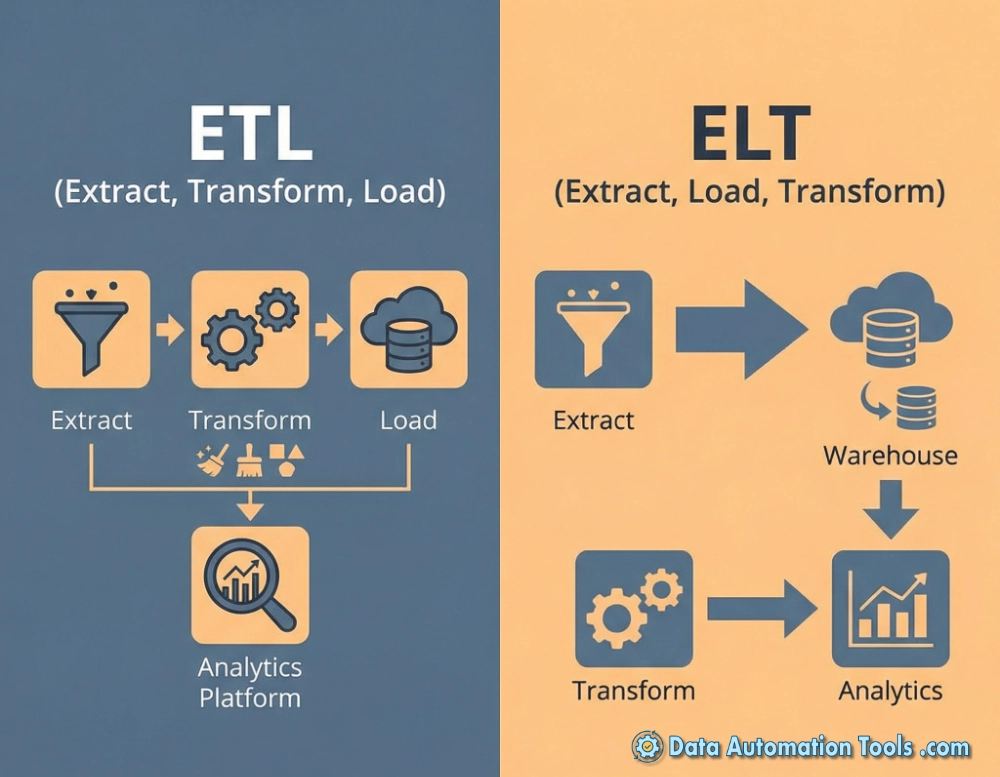
ETL vs ELT is an argument about where power, cost, and control live in your data stack. ETL (Extract, Transform, Load) says you clean and shape data before it ever touches your analytics platform. ELT (Extract, Load, Transform) says you dump the raw data into a warehouse first and do the shaping there.
On paper they sound like simple ordering differences. In practice they change how teams work, who owns data logic, how much things cost, and how much you can trust what comes out the other end. For developers, this isn’t an abstract architectural choice. It determines whether you spend your days babysitting brittle pipelines or writing clean, testable transformations that live in version control.
Why ETL Made Sense in the Old World
ETL was born in a time when databases were expensive, slow, and fragile. You didn’t just shove raw data into a warehouse and hope for the best. You cleaned it first, filtered it, aggregated it, and only then loaded it into your precious, carefully tuned data analytics platform. Tools like Informatica, Talend, and SSIS ruled this world. They ran on separate servers, did heavy lifting in the middle, and handed the warehouse something already polished.
That model fit the economics of the time. Compute was scarce. Storage was expensive. Warehouses were designed for querying, not for being a giant scratchpad for half-baked data. ETL also fit the organizational structure: centralized data engineering teams controlled the pipelines, and business users got whatever was delivered.
The problem is that ETL pipelines turned into black boxes. Logic lived in proprietary tools. Version control was an afterthought. Testing was painful. And when business logic changed—as it always does—updating those pipelines became slow, risky, and political.
How the Cloud Made ETL vs ELT Moot
Then the cloud showed up and quietly torched the assumptions that made ETL attractive. Snowflake, BigQuery, Redshift, and Databricks flipped the economics. Storage became cheap. Compute became elastic. Warehouses turned into massive, scalable SQL engines that could happily crunch raw data all day long.
Once you can afford to store everything and compute on demand, it stops making sense to do heavy transformations before loading. Why throw away data or lock in assumptions early when you can keep the raw truth and decide later how to interpret it?
That’s the heart of ELT. You extract data from sources, load it as-is into the warehouse, and then use the warehouse itself to transform it. Tools like dbt made this model not just viable but pleasant. Transformations became SQL files in Git. Tests became code. Reviews became pull requests. Data logic started looking like real software instead of a tangle of drag-and-drop boxes.
ELT Changes Who Owns the Truth
One of the most underrated effects of ELT is how it changes power dynamics inside a company. In ETL land, the pipeline is the truth. If a metric is wrong, you’re at the mercy of whoever owns the ETL tool and its opaque workflows. In ELT land, the raw data lives in the warehouse, and the transformations that define metrics are visible, queryable, and auditable.
This is huge. It means analysts can explore raw data. Engineers can review transformation logic. Business stakeholders can point to a SQL model and say, “That’s where revenue is defined.” Governance stops being a bureaucratic layer and starts being a property of the system.
That doesn’t mean chaos goes away. ELT can absolutely turn into a swamp of half-baked models if you don’t enforce standards. But at least you’re dealing with code, not mystery meat.
Cost and Performance Are the ETL vs ELT Battleground

Here’s where things get spicy. ELT pushes more work into the warehouse, which means you’re paying warehouse compute for transformations. That’s fine when your warehouse is Snowflake or BigQuery and you can scale up and down. It’s terrifying if you don’t understand your workloads or if your finance team is allergic to variable cloud bills.
ETL, by contrast, lets you do heavy lifting outside the warehouse, often on fixed-cost infrastructure. That can be cheaper in very large, very stable environments. It can also be a nightmare to scale when volumes spike or new sources appear.
The truth is that neither model is inherently cheaper. ELT is usually cheaper for fast-moving teams with modern warehouses. ETL can win in ultra-large, ultra-predictable enterprises that have already sunk millions into dedicated transformation infrastructure.
Data Quality Looks Different in ELT
One of the classic ETL arguments is that you shouldn’t load bad data into your warehouse. In ELT, you absolutely do—and that’s the point. You keep the raw data, warts and all, and build cleaned, trusted models on top.
This gives you something ETL never could: lineage. When a number looks wrong, you can trace it all the way back to the raw source. In ETL systems, the raw data often disappears once it’s transformed. When a bug slips in, you’re left guessing.
With ELT, you can re-run transformations, compare versions, and fix mistakes without re-extracting everything. That’s a superpower for debugging and compliance.
The ETL vs ELT Choice Is Cultural
At the end of the day, ETL vs ELT isn’t just about technology. It’s about how your team thinks. ETL fits a world where data is controlled, slow, and centrally managed. ELT fits a world where data is exploratory, collaborative, and constantly changing.
Most modern teams end up somewhere in the middle. They use ELT for analytics and experimentation, and ETL-style preprocessing for things like streaming, PII masking, or operational systems that can’t tolerate raw data.
But the direction of travel is clear. As warehouses get more powerful and tools like dbt, Airflow, and Dagster mature, ELT keeps winning because it aligns better with how developers actually want to work: in code, in Git, with tests, and with the ability to change their minds without burning everything down.
ETL isn’t dead. But ELT is where the future is being built.