

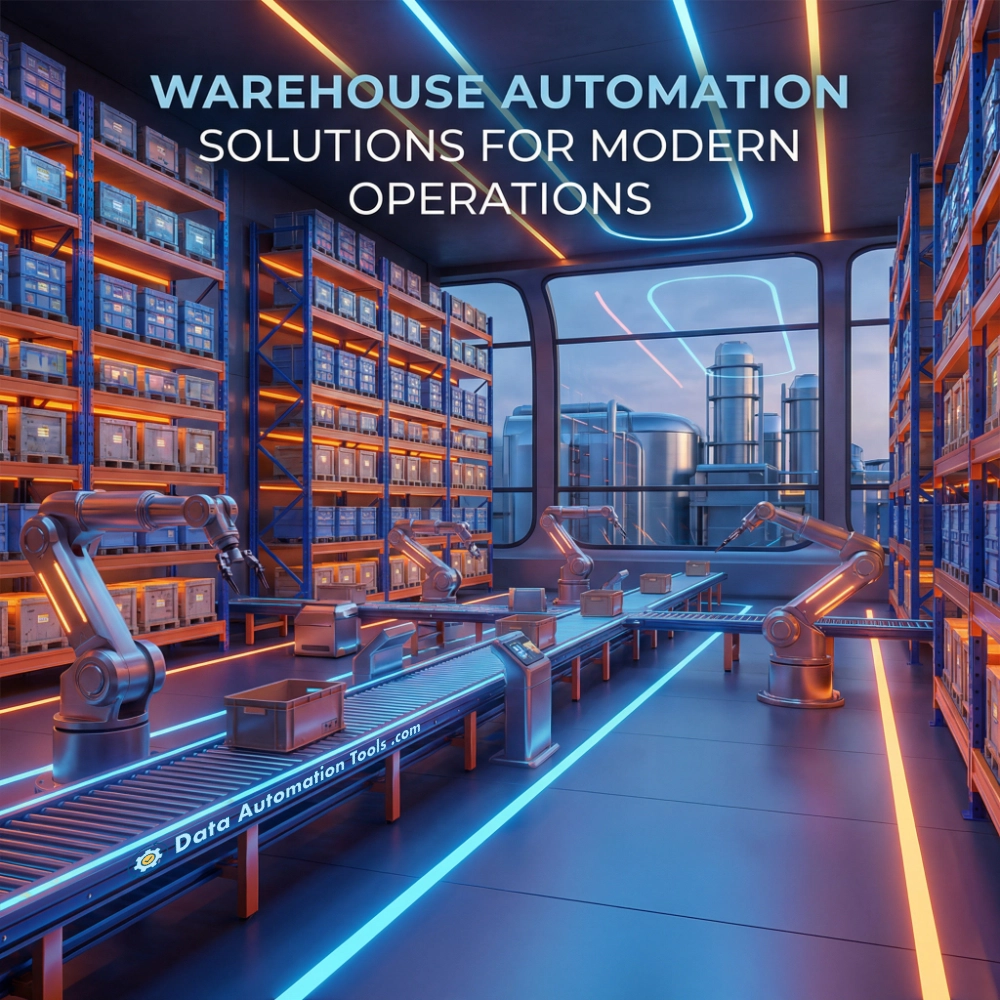
Warehouse automation is the efficiency magic that turns the ridiculous expectation that I can be unboxing the new doo-dad I bought thirty seconds ago by day after tomorrow into reality. The modern warehouse is no longer a big metal box where products quietly gather dust. It’s a high-pressure, always-on machine expected to move thousands of items a day with ninja-level speed and surgeon-level accuracy. I click “Buy Now” and expect near-instant gratification. Warehouse automation is what turns that expectation into operational reality.
At its core, warehouse automation is about replacing slow, inefficient, and error-prone manual work with systems that are faster, smarter, and far less temperamental than humans on their third shift. In practice, it becomes an entire ecosystem of tools—software, robots, sensors, conveyors, and analytics—all working together to move products smoothly from receiving dock to delivery truck.
Warehouses Are Software Systems Now
From the outside, a warehouse still looks like forklifts, shelves, and pallets. From the inside, it looks a lot more like a distributed application with wheels attached. Orders arrive as API calls. Inventory becomes structured data. Robots, scanners, and conveyors turn physical movement into event streams. The modern warehouse is less a building and more a real-time computing problem.
For developers, warehouse automation is where software stops being abstract and starts pushing actual cardboard around. When your code runs, trucks load on time. When it fails, nothing ships. It’s one of the few domains where latency, reliability, and integration bugs have immediate, visible consequences.
The WMS: The Operating System of the Warehouse
Every automated facility revolves around a Warehouse Management System. Think of the WMS as the operating system that coordinates everything else. Platforms like Manhattan Associates, Blue Yonder, Oracle NetSuite WMS, and SAP Extended Warehouse Management maintain the source of truth for inventory locations, order priorities, and task assignments.
From a developer’s perspective, the WMS is a giant integration hub. It ingests orders from ERPs and e-commerce platforms, converts them into pick tasks, and distributes work to scanners, robots, and sorters. Most modern systems expose REST APIs, webhooks, and message queues, which means automation projects often feel like building complex middleware on top of an enterprise platform.
Get the WMS layer right and the rest of the automation stack has a fighting chance. Get it wrong and even the fanciest robots will just stand around waiting for instructions.
Turning Shelves into APIs: ASRS and Hardware Integration
Once the software brain is in place, the hardware muscles come next. Automated Storage and Retrieval Systems—ASRS for short—are essentially industrial databases where the records happen to be physical bins. Vendors such as Dematic, Swisslog, and Honeywell Intelligrated provide cranes and shuttles that store products densely and deliver them directly to picking stations.
Integrating with these systems requires thinking in events instead of screens. A shuttle reports that a tote has arrived. A crane signals task completion. A sensor confirms placement. Your application has to listen, react, and orchestrate the next step instantly. Industrial protocols like OPC-UA and Modbus suddenly matter as much as JSON and HTTP.
Robots as Microservices with Wheels
Robotics takes this complexity up another notch. Autonomous mobile robots from companies like Locus Robotics and Geekplus behave a lot like fleets of tiny networked services. They broadcast telemetry, accept tasks, and fail in wonderfully unpredictable ways.
Developers interact with them through task-management APIs: assign a robot to retrieve an item, reroute it to another zone, or pull diagnostics when something goes sideways. Building reliable workflows around robots means writing solid queue management, retry logic, and graceful fallback paths for when a machine inevitably gets stuck under a conveyor. In warehouse automation, error handling isn’t theoretical. It’s what keeps orders moving at 2:00 a.m.
It Ain’t Sexy, But Warehouse Automation Works
Not every win requires a robot. Some of the highest-impact automation is gloriously practical. Building automation systems automate lighting and temperature. Pick-to-light systems flash LEDs to tell workers exactly where to grab the next item. Voice-directed picking systems from vendors like Honeywell Voice Solutions turn order lists into spoken instructions. Barcode scanners and RFID readers from Zebra Technologies and Impinj stream location data in real time.
For developers, these devices are just more endpoints. But they come with quirks: dropped connections, partial scans, duplicate messages, and flaky networks on a concrete warehouse floor. Writing resilient software here means designing for failure first and optimism second.
Conveyors, Sorters, and the World of OT
High-volume warehouses live and die by conveyors and sortation systems. Companies like Vanderlande and Siemens build the industrial infrastructure that moves thousands of packages per hour to the correct dock doors.
This is where traditional IT meets operational technology. Instead of talking only to web services, developers must interface with programmable logic controllers, proprietary device protocols, and real-time control systems. Middleware and protocol adapters become essential tools, translating business events into machine commands and back again.
Data Integrity Gets Very Real, Very Fast
Inventory tracking might sound mundane, but it’s one of the hardest technical problems in automation. A single missed scan can mean shipping the wrong product to the wrong customer. Duplicate messages can create phantom inventory. Delayed updates can stall an entire workflow.
Handling this requires event-driven architectures, idempotent processing, and careful schema design. Many successful implementations rely on streaming platforms like Kafka or RabbitMQ to ensure reliable message delivery and ordering. In a warehouse, data quality isn’t just nice to have—it’s operational oxygen.
Testing Without Breaking the Building
Testing automation systems is unlike testing normal applications. You can’t exactly run unit tests against a live robot fleet. That’s why serious teams invest in simulations, digital twins, and hardware emulators. Before any code reaches production, workflows are exercised against mock devices and synthetic order volumes. Continuous integration pipelines often include virtual warehouses so developers can validate changes without risking a very expensive traffic jam on the shop floor.
All this complexity pays off in very tangible ways. Automated warehouses ship faster, make fewer mistakes, and scale without hiring armies of temporary workers. Labor shortages become manageable. Peak seasons become survivable. Customers get their orders on time. For developers, few domains are as satisfying. You don’t just deploy code—you watch it move real products, in real buildings, for real customers.
Warehouse Automation is Code That Moves the Physical World
Warehouse automation is where software engineering meets heavy machinery. It demands clean architecture, rock-solid integrations, and a healthy respect for the unpredictable nature of the physical world.
Do it well, and your systems quietly orchestrate thousands of actions every hour. Do it poorly, and nothing ships. In modern operations, robots and conveyors aren’t replacing software. They’re just the most visible endpoints of it. And for developers willing to dive in, there’s nothing quite like seeing your application literally make things move.
Warehouse Automation FAQs
Most automation platforms expose REST or SOAP APIs and support message queues such as Kafka, RabbitMQ, or MQTT. A WMS usually connects to ERPs, e-commerce platforms, and shipping systems through standard integrations, webhooks, or middleware like MuleSoft or Boomi.
Developers will encounter JSON and XML for business integrations, while industrial equipment often communicates using OPC-UA, Modbus, or proprietary vendor protocols. Real-time devices like scanners and robots may stream events over TCP/IP or specialized IoT gateways.
Core order and inventory updates must be near real-time, typically within seconds. Task routing to robots or conveyors often requires sub-second latency, while reporting and analytics can run on a slower batch cadence.
Legacy system integration, inconsistent inventory data, unreliable network connectivity on the warehouse floor, and handling high event volumes are the most common pain points. Clean data and stable infrastructure are usually harder than the robots themselves.
Automation platforms rely on retry queues, dead-letter handling, and manual exception workflows. When a robot or conveyor can’t complete a task, the system must gracefully reroute work to humans without stopping the entire operation.
Simulation environments are critical. Developers typically test integrations using digital twins, mock devices, and staged message feeds before touching live equipment. End-to-end testing with realistic order volumes is essential before going into production.
1. How do warehouse systems typically integrate with existing software?
Most automation platforms expose REST or SOAP APIs and support message queues such as Kafka, RabbitMQ, or MQTT. A WMS usually connects to ERPs, e-commerce platforms, and shipping systems through standard integrations, webhooks, or middleware like MuleSoft or Boomi.
2. What data formats and protocols are common in warehouse automation?
Developers will encounter JSON and XML for business integrations, while industrial equipment often communicates using OPC-UA, Modbus, or proprietary vendor protocols. Real-time devices like scanners and robots may stream events over TCP/IP or specialized IoT gateways.
3. How real-time does a warehouse automation system need to be?
Core order and inventory updates must be near real-time, typically within seconds. Task routing to robots or conveyors often requires sub-second latency, while reporting and analytics can run on a slower batch cadence.
4. What are the biggest technical challenges when implementing automation?
Legacy system integration, inconsistent inventory data, unreliable network connectivity on the warehouse floor, and handling high event volumes are the most common pain points. Clean data and stable infrastructure are usually harder than the robots themselves.