

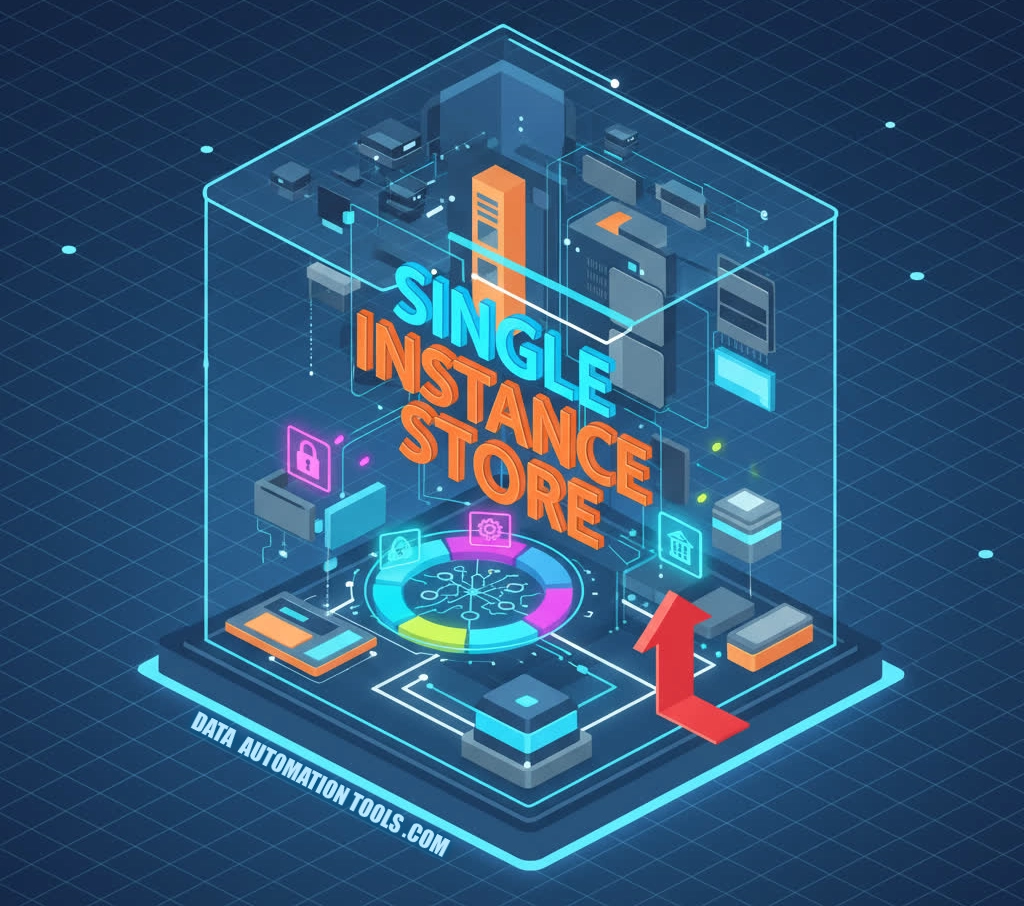
A Single Instance Store (SIS) is the data world’s version of minimalism. The idea is to store every unique piece of information exactly once — no copies, no duplicates, no clones.
Every engineer knows the pain of duplicate data. Two copies of the same table. Three versions of a customer record. Ten slightly different “final” files sitting in an S3 bucket like Russian nesting dolls of chaos.
At some point, someone on your team says, “We should really have one single source of truth.” And that’s how you end up talking about the Single Instance Store — a deceptively simple idea that sounds like organizational Zen and feels like operational whiplash.

What It Actually Means
It’s not a tool. It’s a philosophy — and like all philosophies, it’s incredibly easy to preach and brutally hard to practice.
Because Duplication Is the Silent Killer
At its core, SIS systems identify identical data blocks (or even byte sequences) and consolidate them. Instead of saving the same data a hundred times, they keep one canonical instance and reference it wherever needed.
This concept started in the world of storage deduplication — think file systems, backups, and object stores. But it’s evolved. Now you’ll find the SIS mindset creeping into data warehouses, content delivery, dados as, and even machine learning pipelines. Anywhere data gets cloned, compressed, or copied, someone’s trying to make it single-instance.
Classic SIS Implementation
| Technology | What It Does | Where It Shines |
|---|---|---|
| NTFS SIS (RIP) | Deduplicates identical files at OS level | File servers, archives |
| ZFS Deduplication | Block-level dedup in the filesystem | Backups, snapshots |
| Amazon S3 Intelligent-Tiering | Detects duplicate objects | Object storage optimization |
| Data Vault / Delta Lake Patterns | Logical deduplication of records | Modern data warehouses |
Every SIS implementation dances around the same principle: store once, reference everywhere.
Why Single Instance Store Matters
Duplication doesn’t just waste space — it kills truth. In data systems, every duplicate is a liability. It creates consistency drift (two records disagree), query confusion (which version is real?), and cost inflation (you’re paying twice for storage and compute).
A Single Instance Store fixes that by enforcing a kind of data monogamy. There’s only one copy, period. Everything else is a pointer, a hash, or a symbolic reference.
For backups, this is a game-changer. Instead of storing a full snapshot every night, you store only the deltas. For warehouses, it’s how you avoid storing the same user 10,000 times in different pipelines. For machine learning, it keeps your training data consistent so your model doesn’t learn from its own echoes.
The Catch (Because of Course There’s a Catch)
Implementing a true SIS system is harder than it sounds. First, you need a reliable way to identify duplicates — usually via hashing or block-level fingerprinting. That adds CPU overhead and complexity. Then you have to handle deduplication granularity (files, rows, blocks?) and indexing (how do you find the original instance efficiently?).
And let’s not forget mutability — what happens when the “single” instance changes? If you’re referencing it from a hundred places, now you’ve got a distributed update nightmare.
That’s why many systems fake it. They apply SIS-like principles logically rather than physically. For example, instead of deduplicating storage blocks, a warehouse might deduplicate at query time using DISTINCT or a data modeling convention like surrogate keys. It’s not true single instancing, but it gets 80% of the benefit with 20% of the complexity.
Single Instance Store in the Cloud Era
In the cloud world, SIS isn’t just about saving bytes — it’s about saving sanity. Object stores like S3 and GCS already apply SIS principles behind the scenes. If you upload the same object twice, they hash-match it and skip the extra copy.
Content delivery networks (CDNs) do the same thing globally. One cached image, served to millions. Databricks Delta Lake, Snowflake’s micro-partitioning, and BigQuery’s logical views all take SIS to the logical layer — ensuring that even when data appears in multiple tables or views, it’s actually stored once under the hood.
The goal isn’t just to reduce cost. It’s to make sure your data systems behave deterministically. When you have one instance, you have one truth. Everything else is opinion.
Professor Packetsniffer Sez:
The Single Instance Store is like good engineering hygiene: boring, vital, and often ignored until something breaks. It’s not flashy. You won’t brag about it on your résumé. But it’s the quiet infrastructure pattern that keeps everything else sane.
Without SIS, duplication spreads like rust — silent at first, catastrophic later. With it, your backups shrink, your costs drop, your data stays consistent, and your architecture starts to feel… elegant. So yeah, it’s not sexy. But neither is brushing your teeth. And you do that every day for a reason. The Single Instance Store: because once really is enough.