

Estimated reading time: 6 minutes
Databricks isn’t a database, a notebook toy, or an analytics platform. It’s a managed environment for running large-scale distributed computation, built around Apache Spark and designed for cloud object storage. Databricks exists because Spark is powerful but unforgiving: left on its own, it demands careful cluster management, security plumbing, job orchestration, and a tolerance for operational pain. Databricks takes that complexity, wraps it in guardrails, and sells you back something usable by real teams under real deadlines.
If Snowflake feels like a database you point questions at, Databricks feels like a machine you put work into. Its job is not to answer queries elegantly, but to move, reshape, and analyze enormous volumes of data without collapsing under its own weight.
The Architectural Center of Gravity
Databricks is unapologetically compute-centric. Data does not live in Databricks; it lives in cloud object storage—Amazon S3, Azure Data Lake Storage, or Google Cloud Storage—under your control. Databricks supplies the engines that read from and write to that storage. This separation is not incidental; it is the platform’s defining assumption.
Compute arrives in the form of Spark clusters. Sometimes they live for hours while engineers explore data interactively. Sometimes they exist for minutes, spun up to run a job and torn down immediately afterward. Databricks handles provisioning, scaling, and lifecycle management, which is the unglamorous but essential work that turns Spark from an academic success into an operational tool. For data engineers, this is the real value proposition: distributed compute without becoming a part-time cluster administrator.
Why Files Needed to Become Tables Again
Early data lakes taught the industry a painful lesson: files alone do not behave. Concurrent writes collide, partial failures leave debris, schemas drift, and suddenly “the source of truth” is a directory nobody fully trusts. Databricks’ response was Delta Lake, an open-source layer that adds transaction logs and metadata on top of Parquet files.
Delta Lake restores table behavior—ACID transactions, schema enforcement, versioning—without abandoning the economics of object storage. From the outside, a Delta table behaves like a table. Underneath, it is still files plus a log. This matters because it allows multiple workloads to operate safely on the same data: batch jobs, streaming pipelines, ad-hoc analysis, and machine learning can all coexist without stepping on each other. Delta Lake is the reason Databricks can credibly claim that a “lake” can behave like a dependable analytical foundation.
What People Actually Use Databricks For (and How)
In the wild, Databricks is most often the engine room of data engineering. Raw data lands in object storage. Spark jobs running on Databricks clean it, join it, validate it, and promote it into analytical tables. Those tables then feed dashboards, reports, feature stores, or external systems. This is not speculative; it is the dominant usage pattern described in Databricks documentation and third-party case studies.
Streaming workloads are another pillar. Using Spark Structured Streaming, Databricks processes event data continuously while writing results into Delta tables. The practical payoff is architectural consolidation: batch and streaming pipelines share the same engine and storage layer, rather than branching into separate systems with separate failure modes.
Databricks is also deeply entrenched in machine-learning workflows. It integrates with MLflow, which tracks experiments, models, and artifacts. For data engineers, this means feature generation, training data preparation, batch inference, and retraining pipelines can live alongside ETL jobs instead of being exiled to a separate platform.
Databricks allows users to create and run GPU-backed clusters by selecting GPU-enabled instances when configuring compute resources, enabling distributed parallel processing on graphics processors rather than just CPUs. In both AWS and Google Cloud environments, GPU instance types—such as NVIDIA H100 and A100 accelerators—can be chosen for the driver and worker nodes in Databricks clusters, and Databricks installs the necessary drivers and libraries to support GPU use for machine learning and other accelerateable workloads.
This support is part of Databricks’ Runtime for Machine Learning, where selecting a GPU instance and appropriate runtime exposes the GPUs to Apache Spark jobs and ML frameworks, allowing computationally intensive tasks such as training deep learning models to run on GPU hardware. Some environments also offer serverless GPU compute in beta, which provides managed GPU resources for interactive and scheduled jobs using popular ML libraries like PyTorch or Transformers.
SQL, Analytics, and the Warehouse Line
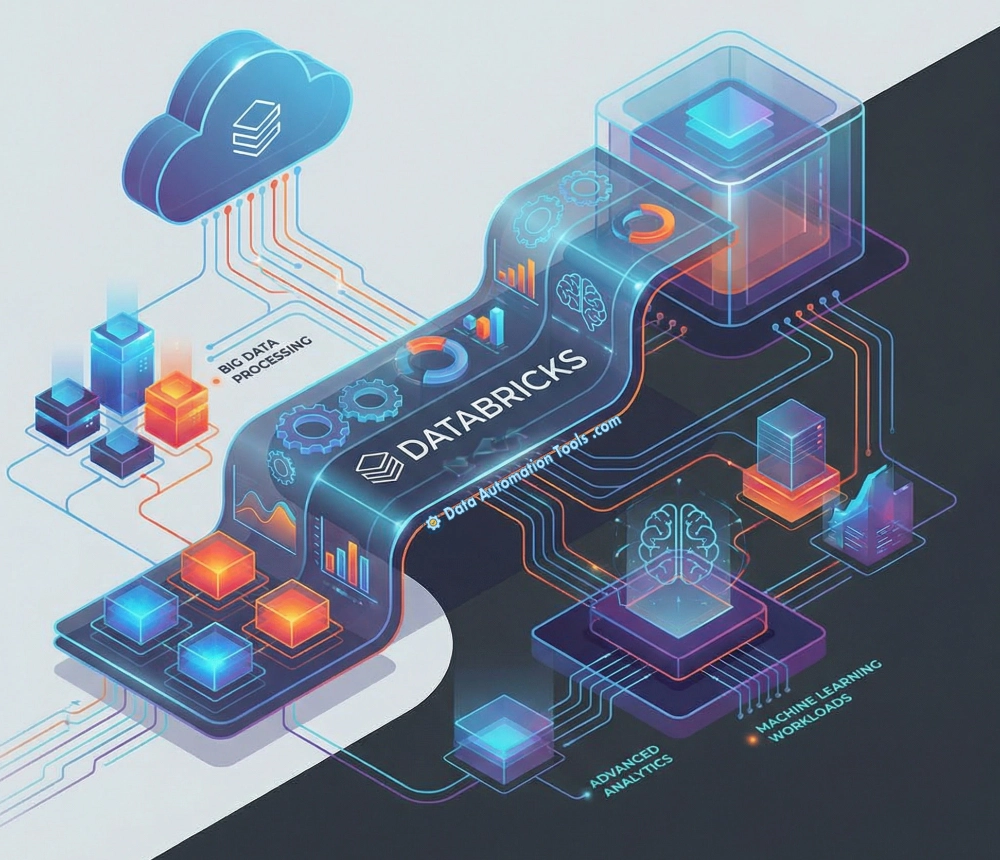
Databricks does SQL, but it does not pretend to be a traditional warehouse. SQL runs on Spark, reading Delta tables from object storage. Databricks has invested heavily in performance improvements and query acceleration, and it offers dedicated SQL endpoints for BI use cases. But the posture remains telling: SQL is one workload among several, not the axis around which the platform revolves.
This distinction shows up in day-to-day use. Databricks shines when the hard part is computation—joins at scale, complex transformations, iterative processing, feature engineering. It is less opinionated about how metrics should be defined or how many executives are hitting the same dashboard at once. For many organizations, that is a feature, not a bug.
Governance Without a Single Persona
As Databricks matured, governance had to catch up. The platform now provides centralized catalogs, access controls, and auditing designed to span data engineering, analytics, and ML. This reflects a reality warehouses learned earlier: when many people touch the same data, governance cannot be an afterthought.
Databricks’ governance model is broad rather than narrow. It is designed to answer questions like “who can read or write this table?” across many kinds of workloads, not just SQL queries. For data engineers, this is pragmatic governance: less about semantic purity, more about making sure pipelines do not accidentally trample each other.
What Databricks Gets Right
Databricks’ most important achievement is not branding the “lakehouse.” It is making large-scale data processing routine. Before platforms like Databricks, Spark jobs were fragile, bespoke, and often heroic. Databricks turns them into scheduled, monitored, repeatable systems. It does not eliminate complexity, but it contains it.
The platform also resists premature specialization. Batch, streaming, and ML workloads live together, which reduces the need to shuttle data between systems just to get work done. That consolidation is often the difference between a stack that scales and one that ossifies.
The Tradeoffs You Don’t Get for Free
Databricks rewards understanding and punishes indifference. Poorly written Spark jobs will happily burn compute. Oversized clusters will happily consume budget. Distributed systems concepts—partitioning, shuffles, state—still matter. Databricks removes operational toil, not the laws of physics.
There is also cultural risk. Notebooks are powerful, collaborative tools, but they blur the line between exploration and production. Teams that do not impose discipline can end up with pipelines that are hard to test, version, or reason about. Databricks enables collaboration; it does not enforce good habits.
The Bottom Line
Databricks is best understood as the place where data becomes work. It is not a database you interrogate politely. It is a platform you load with computation and expect to survive the strain. For data engineers who live in the world of joins, streams, features, and scale, Databricks is compelling because it treats distributed processing as the default, not the edge case.
It does not make data simple. It makes hard data problems solvable—if you respect what the machine is actually doing.