

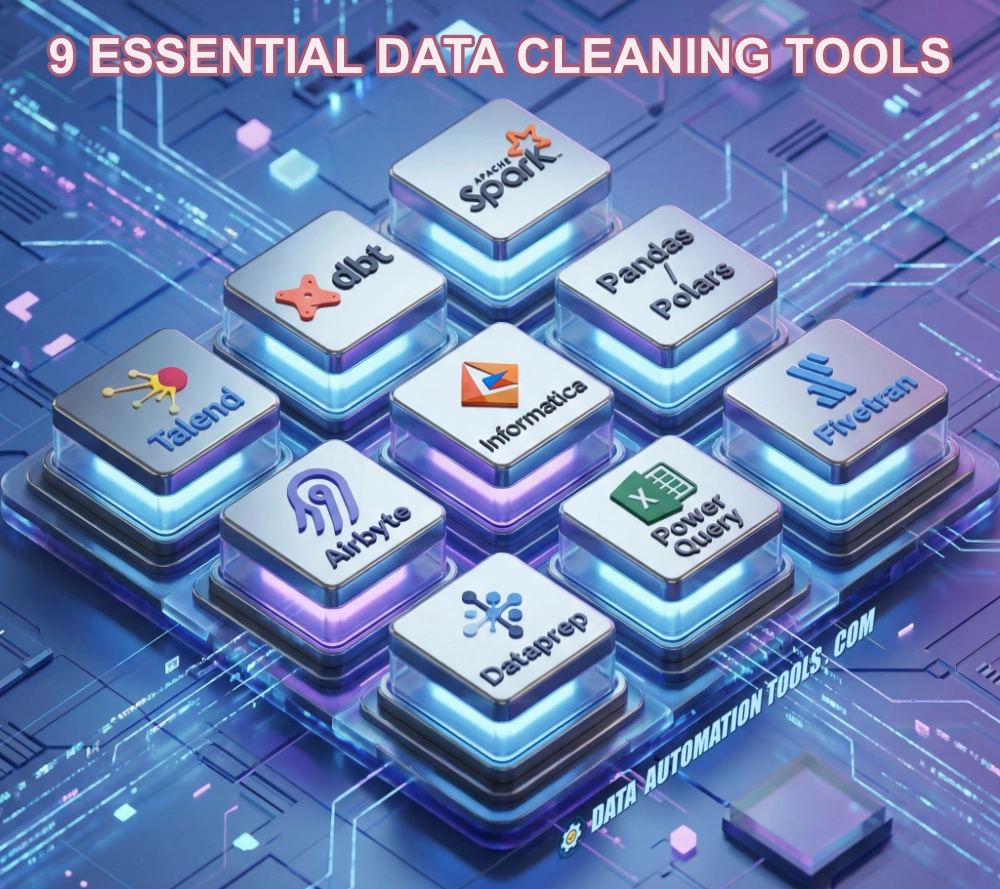
Data cleaning isn’t a “nice-to-have” step before analytics. It’s the step that decides whether your dashboards become trusted decision tools or expensive fiction. The market is full of data cleaning tools that promise to purity, but they don’t all measure up. And while there’s also quite a bit of overlap in what they do (clean data), they each offer unique skills and strengths in what they do and how they do it that make a true comparison that chooses the “best data cleaning tool” a fool’s errand.
This means that the end result of your search for the perfect data cleaning tool for your organization is you may end up with tools – with a capital “S”– that complement one another., But we’ll get into that down the road. For now, here’s the practical, focused look at nine of the most compelling data cleaning tools that I’ve assembled and refined over the years from my own experience as well as countless conversations with other developers. It’s quick and dirty, but lean and mean. This is a list of 9 tools and what they’re great at, where they hurt, and who they’re good for. For deeper dives into each tool, click the link on a tool name to read my thorough review.

dbt is the modern default data cleaning tool for data in the warehouse. It’s best when your data already lands in Snowflake/BigQuery/Redshift/Databricks, etc.
- Strengths: governance-friendly SQL models, testing, docs, strong team workflows.
- Weaknesses: not an ingestion tool; complex non-SQL transforms can be awkward; performance depends on your warehouse.
- What is it good for: standardized analytics models, shared metric definitions, “one version of truth” in SQL-first teams.

Apache Spark is the data cleaning tool you turn to when data is big, messy, and not going to fit neatly into a single-node workflow. It’s more “data processing platform” than “cleaning tool,” but it’s a workhorse for cleaning at scale.
- Strengths: massive scale, distributed processing, strong for semi-structured data.
- Weaknesses: operational overhead, cluster management, steeper learning curve, easy to overkill.
- What is it good for: large-scale transformations, log/event data cleanup, lakehouse pipelines.

If Spark is a freight train, Pandas and Polars are your high-performance pickup trucks. They’re ideal for exploratory quick, surgical transformations—especially in Python-heavy teams.
- Strengths: flexible, fast iteration, huge ecosystem, great for prototypes and custom rules.
- Weaknesses: reproducibility and governance depend on your discipline; scaling can become painful (Pandas), though Polars helps.
- What is they good for: bespoke cleaning logic, prototypes that later move into production, “I need this fixed now” tasks.
Talend is a long-running enterprise integration and data quality platform with a visual design experience. It’s popular in organizations that want structured governance and not want every pipeline living as hand-coded scripts.
- Strengths: mature connectors, enterprise features, strong governance patterns.
Weaknesses: can feel heavyweight, licensing and administration overhead, “ETL suite gravity.” - What is it good for: regulated environments, enterprise integration programs, teams standardizing on a governed ETL.
Informatica is an “enterprise battleship”: powerful, broad, and designed for organizations that treat data management as a strategic program. It shines when data quality, master data, and governance are mandatory—not optional.
- Strengths: deep enterprise capabilities, data quality tooling, governance features, wide adoption in large orgs.
Weaknesses: complexity, cost, implementation effort; not the tool you casually “spin up.” - What is it good for: large enterprises, MDM + governance, cross-domain data quality at scale.
Fivetran is a managed ingestion platform: it gets data out of SaaS and databases and into your warehouse with minimal fuss. It’s not a deep cleaning platform, but it’s frequently step one in a cleaning story.
- Strengths: reliable connectors, low maintenance, fast time-to-value.
Weaknesses: cost at scale; transformation is typically downstream (dbt/SQL); less customization. - What is it good for: standardized SaaS ingestion (Salesforce, Stripe, HubSpot), teams that want less pipeline babysitting.
Airbyte, an open source data cleaning tool, targets the same “extract and load” problem as Fivetran, but with more flexibility and open-source DNA. It’s attractive when you want customization, self-hosting, or connectors you can modify.
- Strengths: extensible, growing connector ecosystem, control over deployment.
Weaknesses: more operational work than fully managed tools; connector quality can vary. - What is it good for: teams that want control, need custom connectors, or prefer open-source economics.
Power Query (a tool in Power BI) is the quiet hero of business teams. It’s a practical, UI-driven way to clean data for reporting without forcing everyone to learn SQL or Python.
- Strengths: approachable, fast for business users, integrates tightly with Microsoft stack.
- Weaknesses: can create “local truth” problems; transformations can be hard to govern; performance varies at scale.
- What is it good for: departmental reporting, self-service cleanup, quick shaping before dashboards.
Google Cloud Dataprep (originally Trifacta) was widely used for visual data preparation in Google Cloud workflows. In many environments, it functioned as an accessible UI for cleaning and shaping data before analysis.
- Strengths: visual cleaning experience, approachable for analysts, good for cloud-based workflows.
Weaknesses: product availability/positioning has shifted over time; may not be the long-term centerpiece of a modern stack. - What is it good for: teams that want visual prep tooling in Google-centric environments, when available and supported.
So What’s the “Best” Data Cleaning Tool?
If you want the best general tool for repeatable, governed data cleaning in analytics stacks, the winner is usually dbt—especially when paired with a warehouse that can scale. It’s the most practical middle ground between engineering rigor and day-to-day usability.
If you’re cleaning at massive scale, Spark is the right hammer.
If you need fast custom logic and your team lives in Python, Pandas/Polars is unbeatable for flexibility.
If you’re an enterprise with strict governance, Informatica (and often Talend) earns its keep—at a price.
And if your primary pain is “how do we even get the data in,” then Fivetran or Airbyte is your first move, with dbt handling the real cleaning downstream.
The Real Stack Reality
Most organizations don’t choose one tool. They build a chain:
Fivetran/Airbyte → dbt → Airflow, with Pandas/Polars for edge cases and Power Query for last-mile business shaping. Big enterprises swap in Informatica/Talend, and high-scale shops add Spark.
The tools don’t compete as much as they complement. The winning strategy is knowing which layer you’re solving: ingestion, transformation, orchestration, or self-service cleanup—and picking the right weapon for that layer.