

Estimated reading time: 7 minutes
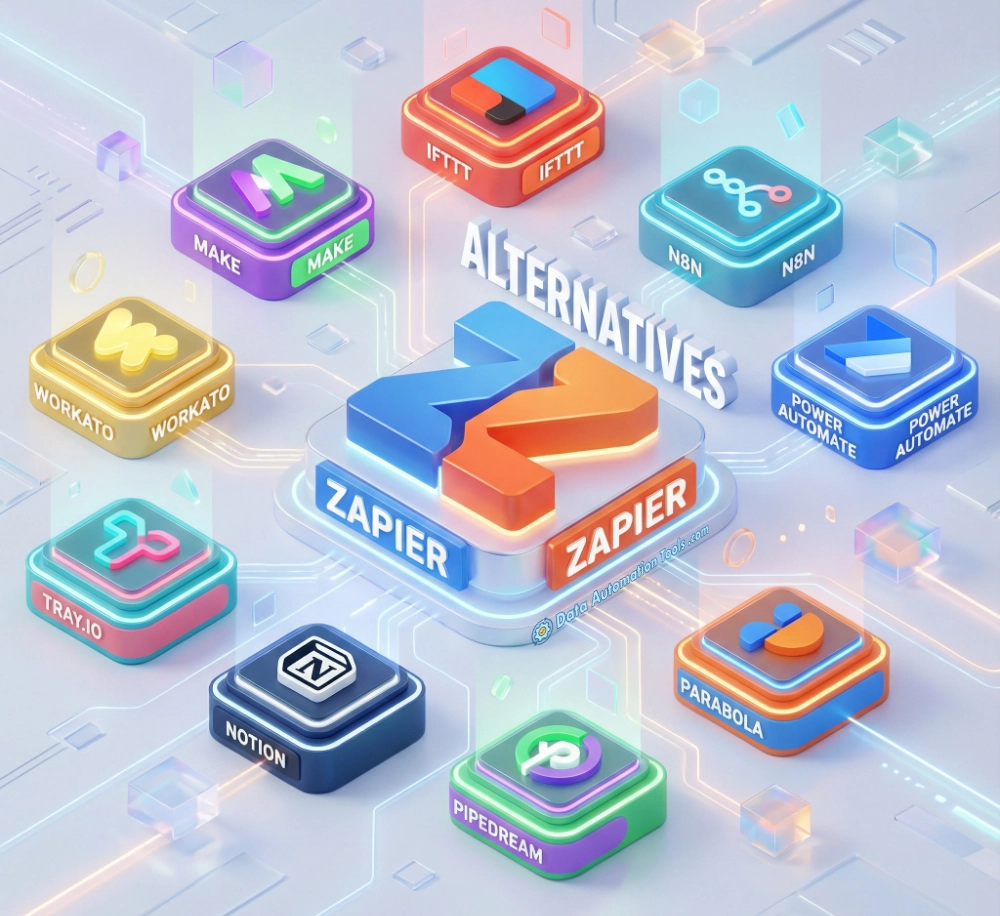
Zapier alternatives are the antidote to the problem of Zapier’s simplicity ceiling. Because while Zapier has become synonymous with workflow automation, once you need more control, better performance, or self-hosting, the “no-code” paradigm starts to feel more like “no-access.”
Zapier is known as being the connective tissue between thousands of SaaS tools. It’s perfect for marketers, small teams, and solo founders who want to connect “when this, do that” actions without writing a line of code. But many organizations hit that simplicity ceiling pretty quickly. Fortunately there are several Zapier alternatives built for devops teams who care about visibility, version control, and scalability.
1. n8n
n8n (short for “nodemation”) is the most natural fit of all the Zapier alternatives for developers frustrated by Zapier’s black-box limits. It’s self-hostable, and built around the concept of nodes — modular building blocks that perform actions or transformations. You can run n8n on your laptop, a server, or inside Docker or Kubernetes.
Unlike Zapier, n8n lets you inject custom JavaScript directly into any node, so you can manipulate payloads, merge APIs, or run logic inline. It supports hundreds of integrations, webhooks, cron jobs, and conditionals — plus you can build your own nodes when something’s missing.
The trade-off: setup and maintenance are your responsibility. You’ll need to manage persistence (PostgreSQL or SQLite), backups, and scaling if you run large volumes of workflows. But for developers who want automation with ownership, n8n hits the sweet spot between no-code convenience and full control.
Use it if: You want a Zapier-like UI but need code flexibility, data privacy, or on-premise deployment.
Stack fit: Works great alongside PostgreSQL, REST APIs, Docker, and small serverless workloads.
2. Pipedream
Pipedream is another strong contender for developers who want cloud-native automation written in JavaScript or Python. Each workflow is a serverless function chain that can react to events, APIs, or schedules. You write code directly in the browser, access npm packages, and manage secrets securely.
It feels like Zapier crossed with AWS Lambda — except you don’t have to manage infrastructure or deployment. Pipedream’s event-driven design means you can stream data between apps in near-real time. It’s especially powerful for integrating APIs, scraping data, or automating CI/CD notifications.
The downside: workflows live on Pipedream’s cloud, so there’s no self-hosting option. But for developers who live in code editors and hate clicking through no-code blocks, Pipedream provides speed, transparency, and serious API flexibility.
Use it if: You prefer coding your automations and want instant deployment without DevOps overhead.
Stack fit: Ideal for API-heavy workflows, analytics, and webhooks.
3. Make (Integromat)
Make (formerly Integromat) targets power users who still enjoy a visual builder but need more control over data structures than Zapier offers. It handles arrays, JSON parsing, branching, and complex logic in a highly visual interface.
It’s not open source, but it’s extremely customizable. Developers appreciate that Make can map, transform, and iterate over collections natively, meaning you can build data pipelines without custom scripts. Its performance is solid, and its pricing model is friendlier for high-volume workflows.
However, debugging can be tedious for large workflows, and local hosting isn’t an option. Still, if your use cases live somewhere between “I want control” and “I want simplicity,” Make offers a strong middle ground.
Use it if: You want Zapier’s usability with more powerful data transformations.
Stack fit: Great for data enrichment, marketing automation, and multi-app workflows.
4. IFTTT
IFTTT (If This Then That) sits at the friendly, consumer end of the automation spectrum. Where Zapier aims at business workflows, IFTTT focuses on everyday life: smart home gadgets, social media posts, personal notifications, and simple cross-app triggers. It’s brilliantly easy to use—pick an event, pick an action, and you’re done. No loops, no complex logic, no deep integrations.
That simplicity is both its strength and its ceiling. For IT professionals, IFTTT feels more like a utility than a platform. You won’t be orchestrating enterprise systems or moving business data through it. But for lightweight automation—syncing calendars, automating reminders, connecting IoT devices—it’s fast, reliable, and painless.
Like Zapier, IFTTT is another automation “gateway drug” of automation. It’s perfect for individuals and small teams who want quick wins without technical overhead. Just don’t expect it to replace real integration tooling when things get complicated.
5. Parabola
Parabola is the alternative built specifically for data-heavy automation. Instead of focusing on app triggers and notifications, it focuses on transforming structured data: cleaning spreadsheets, merging datasets, generating reports, and moving information between systems.
Its visual workflow builder feels more like a lightweight ETL tool than a traditional automation platform. Marketers, operations teams, and analysts use Parabola to automate inventory updates, e-commerce reporting, and bulk data processing without writing scripts.
For IT audiences, Parabola is especially appealing when automation is more about manipulating tables than reacting to events. It fills the gap between Zapier-style workflows and full-blown data engineering tools.
The limitation is scope: Parabola excels at data transformations but isn’t designed for complex application orchestration. When your automation problem looks more like “fix and route datasets” than “connect SaaS apps,” Parabola is often the smartest choice.
6. Notion
Notion isn’t traditionally thought of as an automation platform, but in practice it has become one for many teams. With built-in databases, templates, and third-party integrations, Notion often acts as the operational brain of small organizations.
Native automation inside Notion is still relatively basic, but when combined with tools like Zapier, Make, or Notion’s own API, it becomes a surprisingly capable workflow engine. Teams automate task creation, documentation updates, project tracking, and knowledge management without leaving the platform.
For IT professionals, Notion is less about system integration and more about process automation. It excels at internal coordination rather than heavy data movement. If your main problem is organizing people and information, Notion can be more valuable than a dedicated integration tool. Just don’t mistake it for an enterprise ETL platform—it’s productivity glue, not infrastructure.
7. Power Automate
Power Automate is what happens when automation gets baked directly into the Microsoft ecosystem. If your world runs on Office 365, Teams, SharePoint, Dynamics, and Azure, Power Automate feels less like a separate product and more like a built-in feature.
It offers both simple no-code flows and more advanced RPA (robotic process automation) capabilities. You can trigger workflows from emails, files, forms, databases, or even desktop actions. For IT teams already invested in Microsoft licensing, it often becomes the default choice simply because it’s already there.
Power Automate isn’t always the slickest tool compared to dedicated platforms, but its integration depth is unmatched inside the Microsoft stack. Governance, identity management, and security fit naturally with existing policies. The downside is portability—once you build heavily in Power Automate, you’re firmly in Microsoft land. For many enterprises, though, that’s exactly where they want to be.
8. Workato
Workato is Zapier’s grown-up cousin—the one with a corporate badge and a corner office. Built for enterprise integration and automation, Workato combines workflow automation with deep governance, security, and data transformation features. It’s designed for organizations that need more than simple SaaS-to-SaaS triggers.
From an IT perspective, Workato feels like a full integration platform rather than a consumer tool. It supports complex logic, API orchestration, data mapping, error handling, and role-based controls. You can automate HR onboarding, financial processes, CRM updates, and even cross-department workflows with real operational rigor.
The tradeoff, of course, is complexity and cost. Workato is not a quick hobby tool—you’ll need planning, architecture, and budget. But for companies that require reliability, audit trails, and enterprise-grade scale, it’s one of the strongest automation platforms on the market. Where Zapier is glue, Workato is industrial adhesive.
9. Tray.io
Tray.io targets a very specific audience: technically minded teams that want powerful automation without writing everything from scratch. It positions itself as a low-code integration platform rather than a casual workflow tool.
Where Zapier hides complexity, Tray.io exposes it in a structured way. You get robust data handling, API orchestration, conditional logic, and reusable components. It’s commonly used by product teams to build internal automations, integrate SaaS platforms, and create customer-facing workflows.
From an IT standpoint, Tray.io feels closer to middleware than to consumer automation. It supports large-scale processes, sophisticated error handling, and real governance. The flip side is that it requires more technical skill and planning than simpler alternatives.
If Zapier is for quick fixes and Workato is for enterprise programs, Tray.io lives comfortably in the middle—ideal for growing companies that need power without the full enterprise overhead.
Which is the Right Zapier Alternative For You?
For developers, the “best” alternative depends on control vs. convenience:
| Need | Best Fit |
|---|---|
| No-code speed with code flexibility | n8n |
| Code-first serverless automation | Pipedream |
| Visual workflows with deep data logic | Make |
| Simple, lightweight, everyday automation. | IFTTT |
| Transforming structured data | Parabola |
| Organizing people and information | Notion |
| Microsoft macrocosm integration. | Power Automate |
| Reliability, audit trails, and enterprise-grade scale. | Workato |
| Power without the full enterprise overhead. | Tray.io |
Zapier remains unbeatable for sheer accessibility, but developers need tools that integrate with their stack, respect their data, and scale programmatically. Whether you pick n8n for flexibility, Pipedream for code, or Airflow for scale, the automation landscape of Zapier Alternatives has evolved — and for developers, that’s great news.