

Estimated reading time: 10 minutes
Ask two engineers to compare warehouse vs lake vs lakehouse and then grab some popcorn because you’ve just bought yourself ringside seats to a prize fight. I’ve listened to engineers argue about the meanings of these terms until my eyes glaze over, and if I hear the ol’ “is a lake just a filesystem or a conceptual repository?” argument one more time I might. just… snap. But why so much confusion?
It’s not the applications, it’s the labels. The idea are familiar enough to most people who work in data, it’s just that the terminology isn’t interpreted consistently enough or even agreed upon across the industry. The confusion isn’t about what each does, it’s often about what exactly the terms mean in practice today, especially as each evolves in it’s attempt to be the one thing for everyone.
However, If you ask two engineers how Snowflake differs from S3 + Spark, or how Delta Lake differs from Parquet-on-S3, they will usually give you a technically coherent answer. The uses, they grasp; the terms, they’re slipperier. Why? Because Marketing.
You’ll see this in real engineering conversations. Some people say Snowflake with Iceberg is now a lakehouse. Others say a lakehouse requires Spark-native compute. Others say a lakehouse is just “a warehouse that can read lake tables”. Others reject the term entirely and say it’s just “a data lake with ACID tables”. These disagreements aren’t because people don’t understand the tech. They’re because the terms were invented to position products, not to define architectures.
In the beginning… was the word data lake started as a neutral architectural metaphor, but over time it became attached to Hadoop, S3, big data, raw ingestion, schema-on-read, and sometimes just “cheap storage”. Lakehouse, meanwhile, isn’t a neutral industry term — it’s a vendor-coined neologism that bundles together open table formats (Delta, Iceberg), Spark-style compute, SQL engines, and governance. So, because different vendors mean different things by it, when someone says “lakehouse,” I have to ask “Do you mean the file format, the compute engine, or the vendor platform?”
All this marketing fog affects our attempts to define it and agree on the terms, but in the end, most professionals I talk to understand what warehouses, lakes, and table formats do — they just don’t agree on what data warehouse vs data lake vs lakehouse should mean anymore. Like most things wrong with this world, the noise is in the marketing, not the engineering.
How The Warehouse vs Lake vs Lakehouse Trouble Started
To take a quick through the history for a quick minute, the term data lake was coined around 2010 by James Dixon, then CTO of Pentaho, to contrast with traditional data marts and warehouses by describing a single repository that holds raw, diverse data in its native formats until needed for analysis, rather than forcing upfront structure. Dixon’s idea was that data should be available in bulk first and interpreted later, addressing the explosion of unstructured and semi-structured data in the big data era.
The term data lakehouse is a more recent invention that blends “data lake” and “data warehouse” in both name and technical intent. While the name itself had appeared informally before, it was popularized by Databricks around 2020 to describe an architecture that brings warehouse-like management features (schema enforcement, ACID transactions, query performance) to data lakes via open table formats and unified governance, allowing multiple workloads (BI, ML, streaming) to run over the same underlying storage.
In short, data lake emerged as a metaphor for a broad, unstructured data reservoir in the early big data movement, and data lakehouse emerged later as a way to give that reservoir more of the structured, managed behavior that warehouses had traditionally provided, addressing practical challenges of running analytics directly on lake storage.
Data Warehouses: Databases For Analytics
A data warehouse, in concrete terms, is a managed analytical database optimized for SQL queries over large datasets, typically with many concurrent users and dashboards. The familiar pattern is that data arrives from operational systems, is reshaped into analytics-friendly tables, and then BI tools and analysts query those tables heavily—joins, aggregations, window functions, time-series rollups, and “what changed since last month?” questions.
Modern cloud warehouses sell you a similar core capability with different operational knobs. Amazon Redshift is a fully managed, petabyte-scale data warehouse service. Google BigQuery is a fully managed, serverless enterprise data warehouse. Snowflake runs on public cloud infrastructure with “virtual compute instances and persistent data storage,” with compute supplied by clusters of compute resources required for queries and data-modification operations. Stripped of positioning, what these companies provide is straightforward: a SQL execution environment that’s engineered to be predictable at scale, plus the mechanics of security, metadata, and management that keep the database usable as teams grow.
The important warehouse fact is the default assumption: data is curated into tables intended for querying. You can store semi-structured types in some warehouses, and you can query external formats in some cases, but the warehouse posture is still: get the data into a system that behaves like a database, then treat SQL as the primary interface.
Data Lakes: Storage First, Compute Optional
A data lake is best described not as a “product,” but as an architectural choice: centralize data in low-cost object storage, keep it in many formats, and decide later how it will be shaped for different uses. That storage is usually something like Amazon S3 or Azure Data Lake Storage; it’s engineered to hold massive amounts of data cheaply and durably, regardless of whether the data is neat relational rows or a swamp of JSON, images, logs, parquet files, or sensor dumps. AWS describes a data lake as a centralized repository that can store structured and unstructured data at any scale, often kept “as-is.” Azure Data Lake is engineered to store massive amounts of data in any format and facilitate big data analytics workloads.
A lake by itself does not “do analytics.” A lake is where files live. The analytics happens when you point compute at those files. In other words, a data lake assumes files first: it stores raw data in many formats and only becomes “analytical” when you attach an external engine to interpret those files. A data warehouse, on the other hand, assumes tables first: data is stored in a system that already enforces schema, indexing, metadata, and query behavior, so analytics is the natural, built-in use case.The lake model is therefore intentionally modular: storage is foundational, and multiple engines may read from the same stored datasets depending on the workload.
This modularity is the lake’s strength and its headache. You get flexibility—store everything, keep history, don’t force upfront modeling—but you also inherit the burden of consistency and governance across files, especially when many writers and readers touch the same datasets.
The Lakehouse: Turning Lake Files Into Tables
The lakehouse exists because teams spent years trying to use lakes like warehouses and kept running into the same wall: files are not tables unless you add table behavior. The lakehouse pattern is the attempt to keep lake economics and openness (object storage, common file formats) while adding the database properties that make warehouses dependable: schema enforcement, transactional updates, consistent reads, concurrency-safe writes, and governance.
Technically, lakehouses are made plausible by open table formats—systems that impose table semantics on top of files in object storage. Two of those commonly used formats are Delta Lake and Apache Iceberg. Delta Lake is an open-source storage layer that brings ACID transactions to Spark and big data workloads; it extends Parquet data files with a transaction log for ACID transactions and scalable metadata handling. Apache Iceberg is a high-performance format for huge analytic tables that brings the reliability and simplicity of SQL tables to big data and enables multiple engines to safely work with the same tables at the same time; AWS and Google similarly describe Iceberg as an open table format designed for large-scale analytical datasets in data lakes.
How Warehouse vs Lake vs Lakehouse Compare in Practice
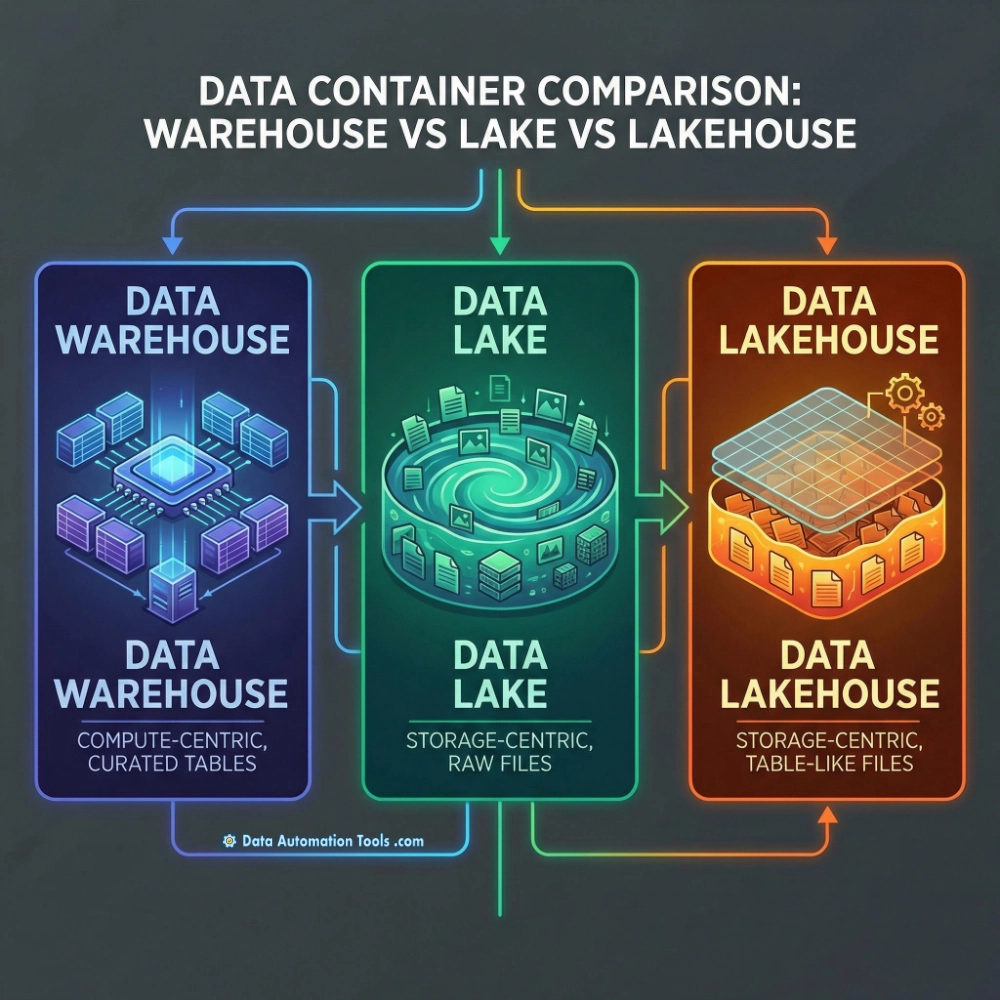
Once you accept “open table formats + object storage,” data warehouse vs data lake vs lakehouse becomes a matter of platform packaging and governance. Databricks explicitly frames the lakehouse as combining benefits of lakes and warehouses and documents it as an architectural pattern supported on its platform, with governance provided by components such as Unity Catalog. In parallel, systems that began as warehouses have moved toward lakehouse interoperability: Snowflake documents support for Apache Iceberg tables, including configurations where data and metadata live in external cloud storage you manage, allowing Snowflake to query lakehouse-style tables.
The warehouse model shines when the priority is high-concurrency SQL analytics with strong operational boundaries. Warehouses are built to be the shared backbone for BI tools and reporting workloads, where predictable response times and controlled governance matter more than maximal format flexibility. Their ecosystem is rich in SQL-centric workflows: transformations, metric layers, and dashboarding.
The lake model shines when the priority is cheap, broad storage for many data shapes, especially when you expect multiple compute paradigms—batch, streaming, ML—to coexist. Lakes are frequently the landing zone for raw ingestion, long-term history, and data types that don’t fit cleanly into relational tables. The trade is that you must deliberately build the governance and table semantics you want; otherwise you end up with data that is stored but not reliably consumable.
The lakehouse pattern exists to reduce the duplication and friction created when organizations run both: a lake for storage and ML, and a warehouse for BI. By adopting open table formats, a lakehouse tries to let multiple engines share a single canonical table representation in object storage. You can query those tables with SQL engines (including distributed ones like Trino, which describes itself as a distributed SQL query engine built for efficient analytics) and also process them with Spark or other compute frameworks. The trade is that you’ve moved more responsibility into the “table layer” and catalog: metadata correctness, compaction/maintenance, and governance become central operational concerns.
The Bottom Line Stripped Of Hype
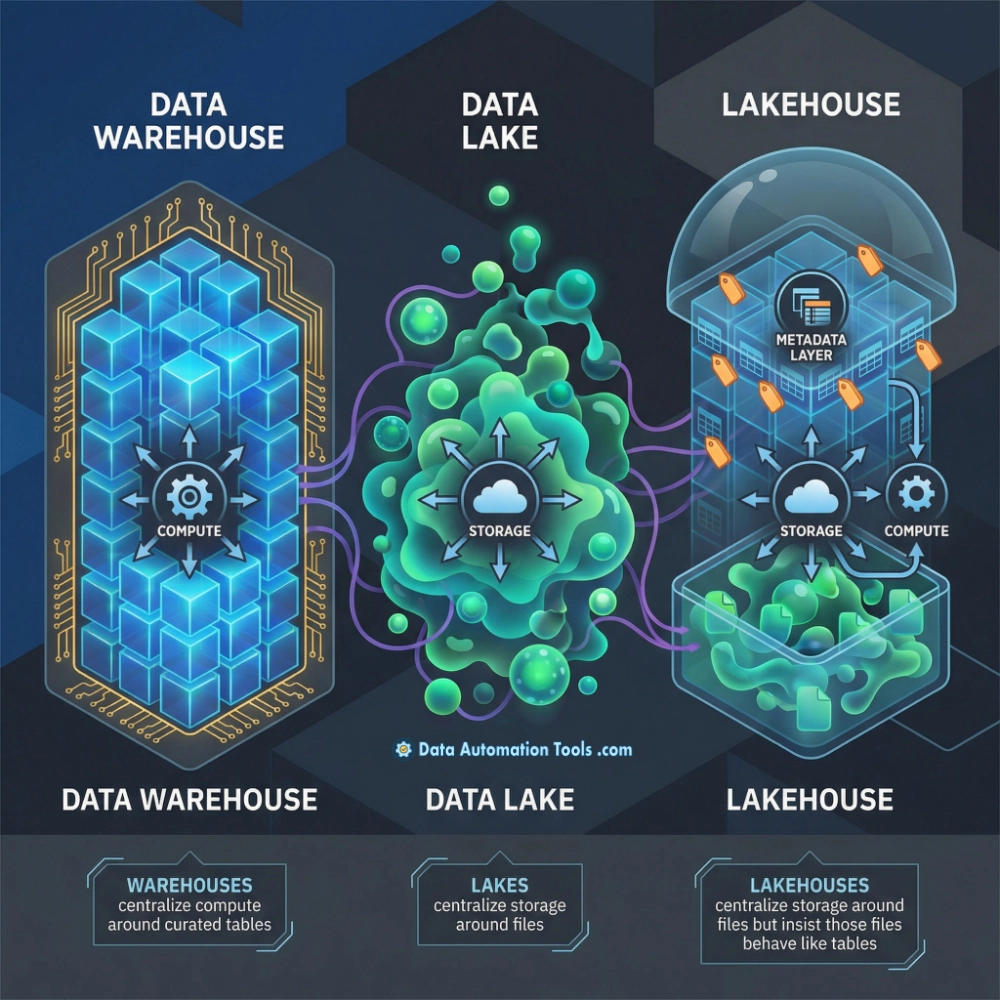
If you want one rule of thumb without the marketing spin: warehouses centralize compute around curated tables; lakes centralize storage around files; lakehouses centralize storage around files but insist those files behave like tables. A warehouse is a database built for analytics, and its vendors sell managed substrates for SQL execution with concurrency and governance as first-class concerns. A lake is a storage estate built for scale and flexibility, and its vendors sell durable object storage plus optional query and processing engines. A lakehouse is a way of making lake storage behave like tables using open table formats, then running multiple engines over that shared representation—sometimes via a single platform, sometimes as a composable stack.
Warehouse vs Lake vs Lakehouse FAQs
A data warehouse stores curated tables for SQL analytics, a data lake stores raw files in object storage, and a lakehouse stores files in object storage but enforces table behavior on them using open table formats.
Warehouses manage data inside a database system, lakes store data in cloud object storage (like S3 or ADLS), and lakehouses also use object storage but layer table metadata and transaction logs on top of the files.
Warehouses are usually best for BI because they’re optimized for high-concurrency SQL queries, while lakes require additional engines, and lakehouses aim to support BI through SQL engines over lake tables.
Lakes and lakehouses are generally better for data science and ML because they store large, diverse datasets cheaply and are easier to process with distributed compute frameworks.
Not universally. Lakehouses reduce duplication by serving multiple workloads from the same storage, but many organizations still use warehouses for predictable BI performance and governance.
Warehouses enforce governance at the database layer, lakes require external catalogs and policies, and lakehouses rely on table formats and catalogs to enforce governance across multiple engines.